
The Automotive Deuce
The Two of Diamonds fully encapsulates the delicate balance between opposing forces, just as an engine crankshaft uses paired counterweights to balance its rotation.
11/4/20251 min read
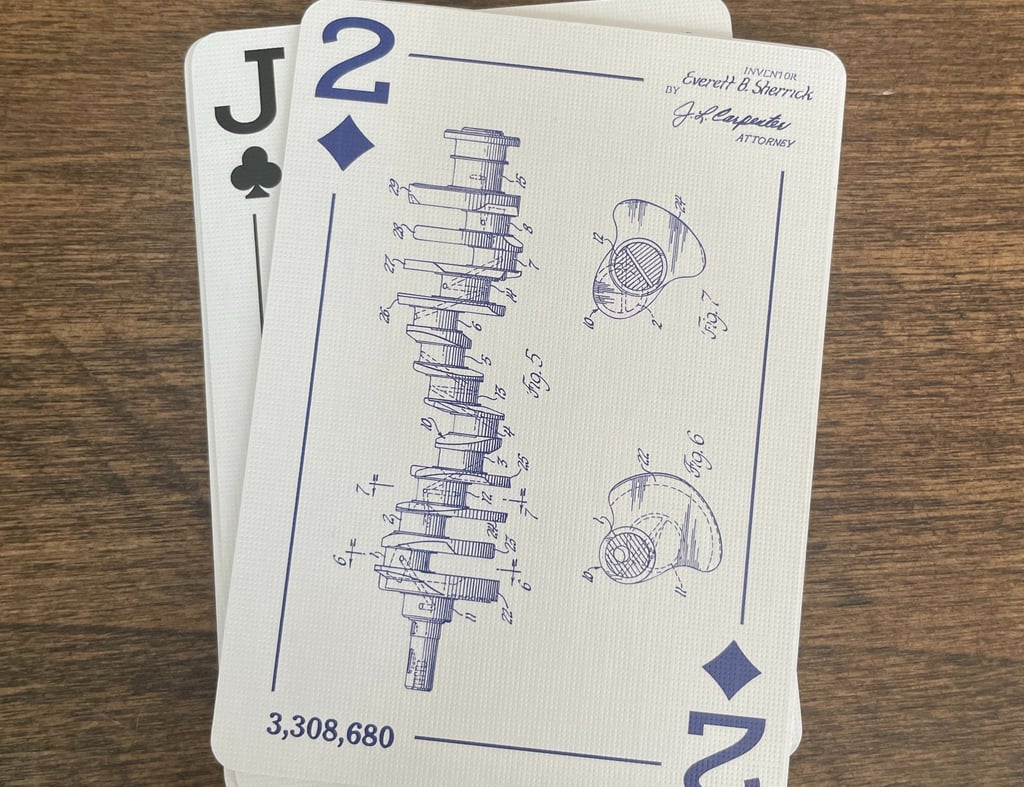
The balanced crankshaft of the Two of Diamonds represents harmony in pairs. Since the beginning of heat engines - steam, internal combustion, Stirling, and beyond - counterweights have been paired with pistons to eliminate vibrations.
US Patent 3308680 specifies a "crankpin arrangement and balancing means for a V-8 engine with cylinder bank angle of 60 degrees". In this arrangement, opposing forces are mitigated by a series of counterweights and opposing pistons to effectively produce smooth rotation that minimizes vibration in the crank shaft.
By adding mass farther from the crankshaft’s axis of rotation, counterweights generate centrifugal force during rotation. This force acts outward, opposing the non-rotational inertial forces created by the pistons and connecting rods as they accelerate and decelerate. These piston forces are primarily vertical and reciprocating, causing uneven vibrations.
Without these counterweights, the crankshaft would vibrate violently. The engine would produce loud knocking forms and ultimately - premature failure.
KboxCo Playing Cards
Questions? Concerns? Reach us at kboxcalendars@gmail.com
© 2026. All rights reserved.