
The Four of Clubs - Devil's Bedpost
The Four of Clubs was coined "The Devil's Bedpost" in the 18th and 19th century, linking it to bad luck and imminent disaster.
Kevin Bockius
1/11/20262 min read
Edo, 1657: A priest prepares a ceremonial altar, one single furisode kimono draped at its center — a quiet moment that will soon ignite one of the deadliest fires in history. The kimono is set to be ceremoniously cremated due to an alleged curse it holds. Three young girls had previously owned it, but all mysteriously died before ever wearing it.
As the priest sets the fire, a gust of wind swirls by. The results are catastrophic - nearly the entire city is decimated, with the fire even spreading it's way to the central palace. Edo was equipped with fire brigades, but their equipment was not sufficient for the tightly packed, wooden buildings.
A standard Edo fire crew used demolition to tear down buildings and create fire breaks to prevent spread (much like present day hotshot crews). They also carried buckets and bucket-chaining equipment - but lacked any pumps for creating water pressure. They attempted to use soaked heavy blankets to prevent spread, but nothing was sufficient for the conditions they were met with.
Throughout history, fires have swept through population hubs like ferocious viruses. Decades of infrastructure - gone in hours. Engineers have pondered fire prevention since the dawn of civilization, going as far back to the Ancient Egyptians, Greeks, and Romans.
In 1801, newly adopted cast iron pipes laid ground work for a new revolutionary invention - the above ground fire hydrant. These were first patented in 1801 by Frederick Graff - the Chief Engineer of The Philadelphia Water Works. The patent was unfortunately lost, ironically, in an 1836 US Patent office fire.
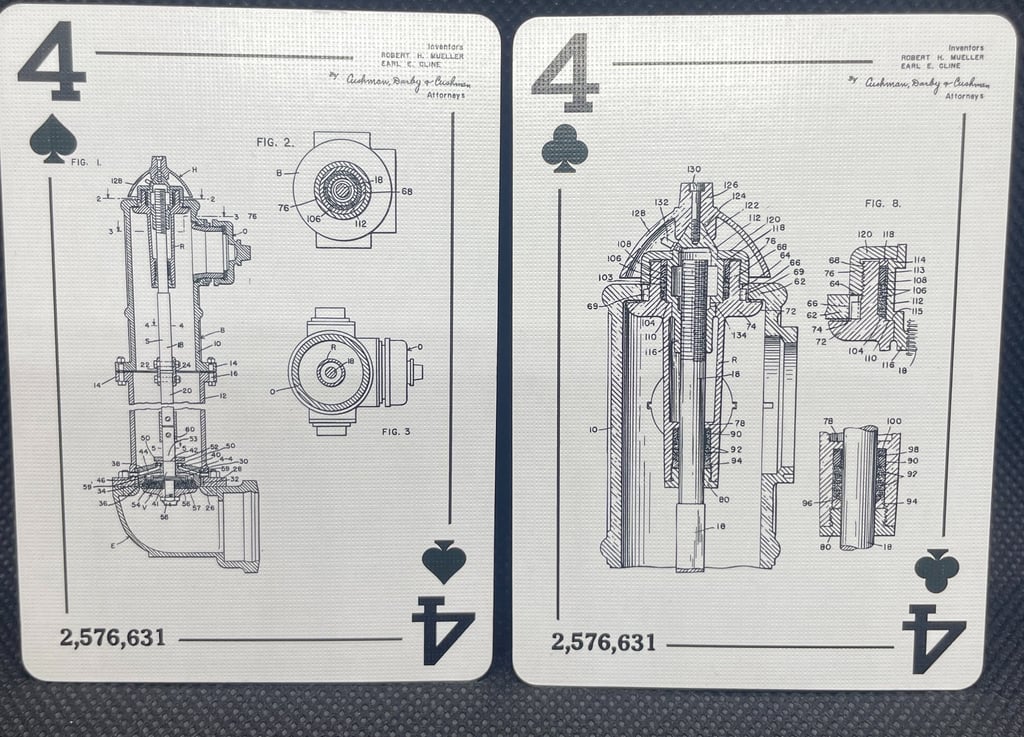
Featured in The Engineer's Deck, US Patent 2,576,631 "Fire Hydrant Valve Operator" describes improvements made to fire hydrants of that time period (1946). The Patent focuses on the operating nut and valve stem interaction - a critical part of a hydrants opening/closing operation. The inventor, Robert H Meuller, describes an improved oil reservoir surrounding all frictionally engaging moving parts - massively reducing cyclic failures. Meuller also describes a shock proof exit nozzle - designed to reduce leaking after numerous open/closing cycles. Additionally, the internal positioning of various critical parts offered improved maintenance procedures that enabled maintenance technicians to repair important parts without having to completely disassemble the unit. Meuller's 1946 patent is a textbook example of good engineering. It successfully improves the longevity, maintenance, and operation of a fire hydrant.
I chose to make the Four of Clubs a fire hydrant to counteract the dark, unsettling lore of The Devil's Bedpost. The Four of Clubs is a bad omen hinting at a major setback or misfortunate event on the horizon. Fire's have been historically detrimental to human civilization - but fire hydrants have helped us stay prepared and ready at all times. Disasters, bad luck, and misfortune are inevitable throughout history. Thankfully, talented engineers have kept society operationally ready for these unforeseen events and have saved countless lives in the process.
KboxCo Playing Cards
Questions? Concerns? Reach us at kboxcalendars@gmail.com
© 2026. All rights reserved.